
Angle Grinder or Circular Saw: Which Cuts a Distributor’s First Order Better
One removes metal at 10,000 rpm, the other cuts timber at 4,500. Selling them as interchangeable is how a cutting category becomes dead stock.

Both tools cut. That is where the similarity ends, and it is why distributors who buy them as if they were interchangeable end up with a container that is half dead stock.
A grinder removes material with an abrasive disc at high speed. A circular saw separates material with a toothed blade at low speed. One is a finishing tool that also cuts; the other is a cutting tool that only cuts. Selling them into the same customer list without that distinction is how a range gets a reputation for being “the cheap stuff”.
What each tool actually does
A cordless angle grinder spins a 115mm or 125mm disc at roughly 8,000 to 11,000 rpm. That speed is what lets an abrasive disc cut steel, stainless, tile and masonry. The same body, with a different disc, grinds welds, strips rust and finishes concrete. It is a two-function tool: cutting and surface work.
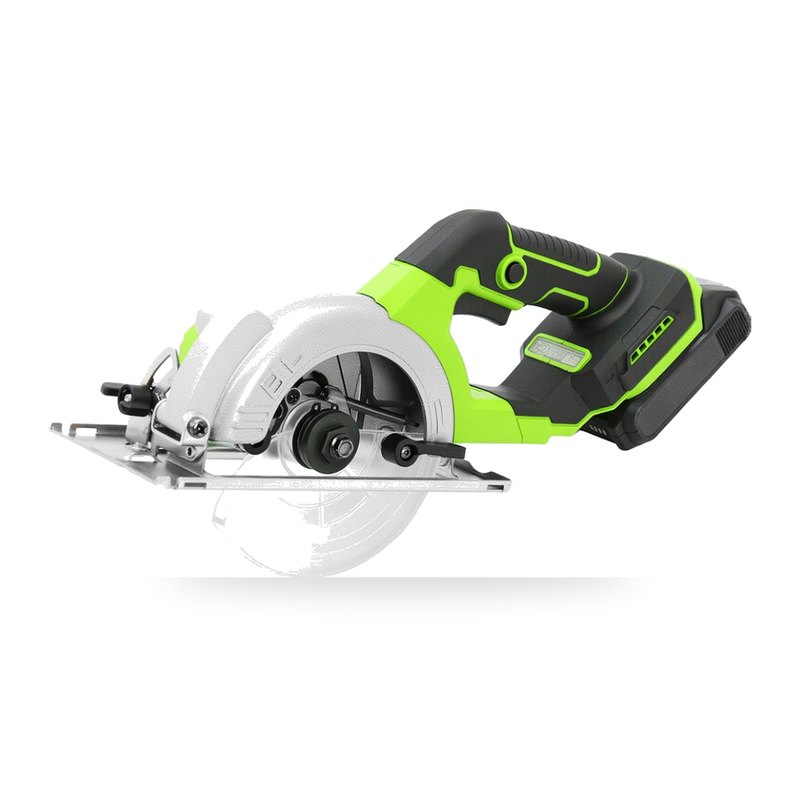
A circular saw turns a 165mm or 185mm toothed blade at 4,000 to 5,000 rpm. Low speed, high torque, and a depth-of-cut adjustment that lets the operator set the blade to the thickness of the board. It cuts timber, plywood, MDF and composite decking — cleanly, with a kerf rather than a burr.
Put simply: the grinder is judged on how fast it removes metal, the saw on how straight and splinter-free the edge is.
The differences a customer notices in the first week
| What matters | Angle grinder | Circular saw |
|---|---|---|
| Cut finish | Burr on the cut edge; usually cleaned up afterwards | Clean kerf, minimal splintering with the right blade |
| Heat | High — sparks, discolouration near the cut | Low — the blade and the board stay cool |
| Battery draw | Very high; a 4.0Ah pack is gone in minutes under load | Moderate; a pack lasts a working session |
| Typical buyer | Metalwork, construction, automotive, tile | Timber framing, decking, fit-out, joinery |
| Failure mode | Overheat, switch, burnt motor | Blade bind, bent base plate, weak motor |

Which one your market buys first
The market decides, not the catalogue. If your customers are metal fabricators, welders, tile layers or general construction, the grinder is the higher-velocity product — it is often the first cordless tool a workshop buys after a drill. If they are carpenters, decking installers, shopfitters or timber traders, the saw moves first and the grinder is an add-on.
There is a third pattern worth knowing: in markets where a large share of buyers are renting or reselling to rental fleets, both tools sell as a pair, because a rental counter cannot afford to turn a customer away over one missing tool.
Ask your first ten customers what they cut last month. The answer tells you the ratio for the whole first container.
Battery and platform implications
These two tools stress a battery platform in completely different ways, and that has a commercial consequence.
A grinder is a continuous high-draw load. On a 5-cell pack it will hit thermal cutoff before it hits empty, and customers will blame the battery. If you sell grinders on a single-platform range, plan for a higher share of spare packs per tool than you would for drills — otherwise your after-sales inbox fills with “the battery only lasts five minutes” complaints that are not actually battery faults.

A circular saw is a torque tool. It will expose a weak motor or a low-discharge cell faster than a grinder will, because a saw that bogs down in wet timber is immediately obvious to the operator. If you are comparing two quotations for the same saw, cut a 50mm piece of hardwood with both. The one that keeps its speed is the one built with a better motor and cell — and it is usually not the cheaper quotation.
Safety and documentation points buyers ask about
Both tools are high-risk categories in most markets, and the documentation matters more than the spec sheet.
For a grinder: a tool-free adjustable guard, a proper side handle, and a spindle lock that is not made of soft metal. Kickback from a binding disc is the single most common serious injury in this category, and a guard that cannot be repositioned without a spanner gets removed by the operator within a week.
For a saw: a lower blade guard that returns freely, a riving knife where the market requires it, and a base plate that stays square after a drop. Ask for the drop test and the guard-return test in the inspection report, not just the CE file.
On documentation, both need the CE package (LVD, EMC, RoHS) for the EU, and GS if you are selling into Germany. Neither needs UN38.3 on its own — that belongs to the battery pack — but any kit that ships with a pack does.
What to put in the first order
If you have no data yet, a defensible starting ratio is two grinders to one saw, in bare tool plus a small number of kits. The grinder carries more replacement and accessory business — discs, flanges, backing pads — and accessories are what keep a customer coming back between tool purchases.
Then let the first month of sell-through set the second ratio. Do not reorder on the container ratio; reorder on what actually left the shelf.
Questions we get most
Can a grinder cut wood?
Not safely or well. A wood-cutting disc exists, but the rpm, the guard and the kickback behaviour are designed around abrasive discs. Sell the saw for wood.
Is a 125mm grinder better than 115mm?
It has more capacity and more torque, and it is the standard in most EU markets. 115mm still dominates where customers buy on price and disc availability. Stock the one your market’s accessory shelves actually support.
Do these tools sell better as kits or bare tools?
Bare tools for customers who already own the platform, kits for everyone else. If you are launching a platform, kits convert; once the installed base exists, bare tools carry the repeat business.
Next step
Both tools sit on the same battery platform in our range — 107 tools, one pack. If you are assembling a first cutting category, the seven-point supplier checklist covers the MOQ, packing and certification side, and the battery platform guide explains why the pack interface, not the voltage label, decides what you can stock together.
Tell us the market and the two or three applications your customers work in, and we will come back with a suggested cutting-tool mix, MOQ and the certification file for each model.