Private Label Power Tools: What OEM Cordless Tools From China Really Cover
Five layers of customisation, one certificate question, and the artwork approval that decides whether your first container ships on time.

Private label power tools are sold on a single promise: this tool carries your brand, your packaging and your price. What that promise covers varies more between suppliers than between tool models, and the gap is where most programmes lose their first year. Buyers assume OEM cordless tools China suppliers quote as one package are delivering one package of rights.
This guide separates what is genuinely customised from what is only relabelled, so you can scope a private label cordless tool programme before artwork approval rather than after the first container lands.
OEM cordless tools China suppliers: what OEM actually covers
Three terms get used interchangeably in this category and should not be. White label vs private label tools is the first distinction: white label is a stock product with your logo applied; private label is a product configured for you inside the supplier’s existing tooling.
OEM vs ODM cordless tools is the second. ODM means the supplier designed the tool and offers it to several buyers with variations. That is what most private label programmes actually are, and there is nothing wrong with it — as long as nobody in the contract claims exclusivity that does not exist.
So the honest question is not “are you an OEM factory”. It is: which layers can I change, what does each change cost in tooling and time, and who owns the result.

The five layers of a private label power tools programme
Every private label power tools manufacturer works within these layers, whether or not they describe them this way. Ask for each one explicitly.
| Layer | What can change | Cost and time driver |
|---|---|---|
| 1. Housing and colour | Housing colour, overmould colour, printed logo on the body | Colour runs need volume; logo printing may need a pad or plate |
| 2. Labels and rating plate | Model designation, rating label, serial format, warning text | Artwork approval only, but the label must match the certificate |
| 3. Packaging | Colour box, BMC or blow mould insert, inner and master carton | Dieline and print run; a new case shape needs tooling |
| 4. Manual and inserts | Language set, brand block, warranty text, QR to your support page | Translation and proofing; content must match the shipped configuration |
| 5. Battery and charger | Pack label, charger label, plug type, voltage variant | New plug or voltage variants carry their own approvals |
Most first programmes buy layers 2, 3 and 4 and assume they have bought 1 and 5. That misunderstanding surfaces at the first reorder, when the buyer asks for a second model in the same livery.
Tool housing colour customization
Tool housing colour customization is the layer buyers care about most and the one with the longest shadow. A colour change usually means a production run in that colour, which means either a minimum quantity or waiting for a scheduled run. It also means the housing you certify is the housing you ship: change the material or the mould and the file has to follow.
Pick one hero tool and one colour first. Prove the colour sells before committing a second and third model to it, because a range in a colour that does not sell is a warehouse problem, not a branding one.
Certification certificate in whose name
This determines what you can actually sell, and it is decided long before packaging. A CE declaration of conformity, a GS certificate, a UKCA file or a UN38.3 report names a manufacturer and a model. If your brand is on the housing and the supplier’s name is on the certificate, you are selling a relabelled product — a legitimate position, provided your importer obligations are met and a market surveillance authority can follow the trail.
Two questions to settle in writing. Will the certificate be issued in your company name as importer or brand owner, and what does the supplier need from you to do that? And when a model is revised, who notifies whom, and how long before the revised tool ships?
Artwork, dielines and the approval that matters
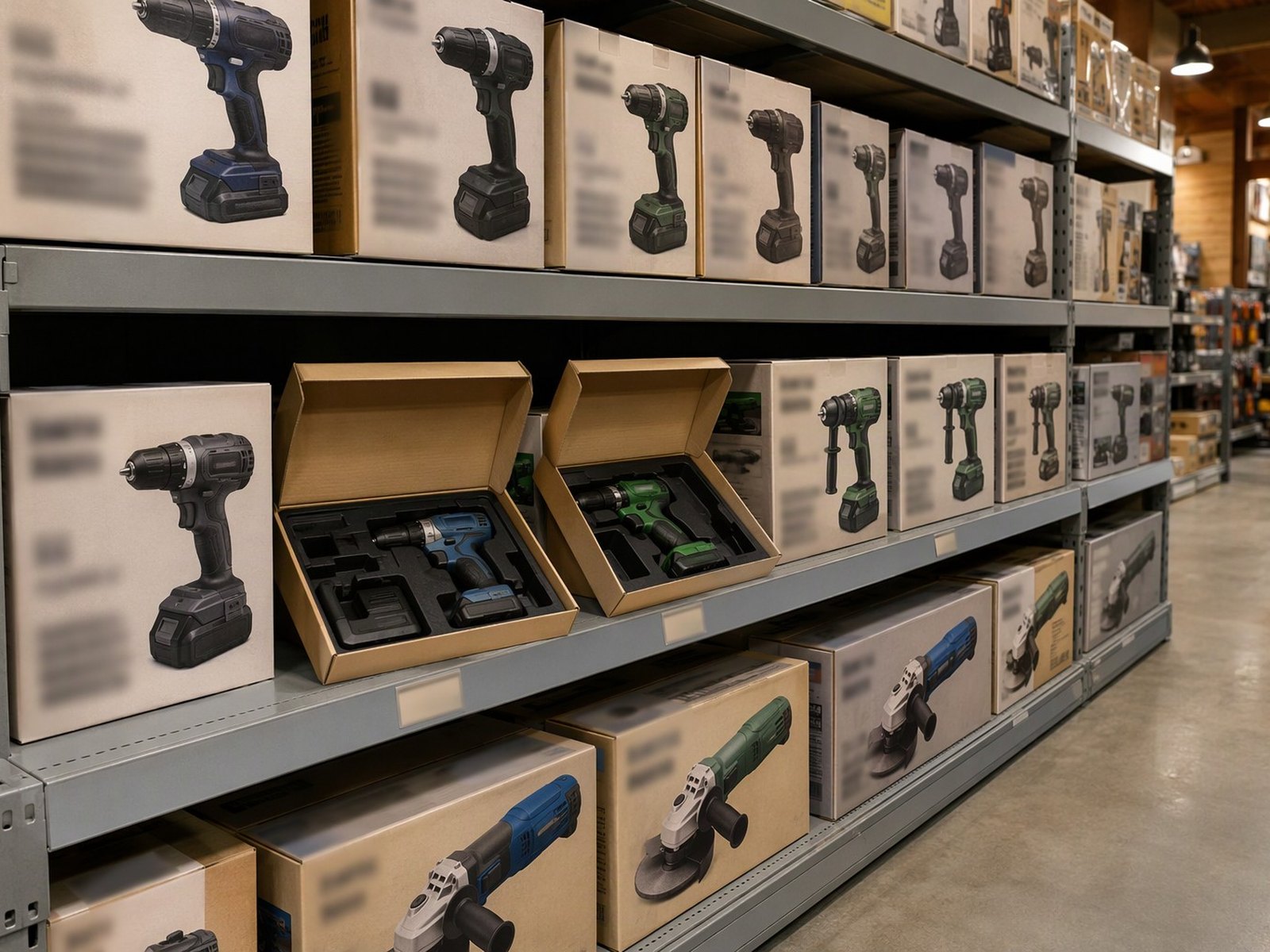
Private label tool artwork approval is where schedules slip, almost always for the same three reasons: artwork approved on screen rather than on a printed sample, a dieline that does not match the case actually used, and a manual translated after the print run rather than before it.
Insist on a physical pre-production sample of the full pack — box, insert, label, manual — before the run. Check three things: does the model number on the box match the tool and the certificate; does the manual describe the battery and charger actually in the case; does the barcode scan to your item, not the supplier’s.
Custom battery pack branding and the charger trap
Custom battery pack branding is usually limited to the label and the pack colour, because cells and protection board are shared across a range. That is fine and cheaper than most buyers expect. What is not fine is assuming a branded pack changes the platform: it does not, and a customer who buys your branded pack and a bare tool from the same supplier’s range will expect them to fit.
The charger is the more common trap. A programme that changes the plug type or input voltage creates a variant with its own approval requirements, and a charger shipped under the wrong market’s file is a compliance failure that no packaging quality compensates for.
Private label minimum order quantity, honestly framed
Private label minimum order quantity is not one number. It depends on how many layers you change: a label-only programme starts far lower than one with a new colour, a new case and a new manual language set. Ask for the MOQ per configuration, not per model, and ask which changes are free and which trigger a new run. If the answer is a single number for everything, the supplier has not costed your configuration yet.
Questions we get most
Can I get an exclusive design?
Inside a supplier’s existing tooling, exclusivity is usually a colour and packaging commitment at volume, not a unique tool. A genuinely unique housing needs new tooling — a different project, budget and timeline.
Do I need my own certification as the brand owner?
In most markets the importer, or the entity placing the product on the market, carries the obligation. Whether the certificate is issued in your name depends on the scheme and the supplier’s role. Settle it in the contract, with the file attached.
How long does a private label programme take?
Long enough that the critical path is artwork and approval, not production. Buyers who approve a printed sample early recover weeks later; buyers who approve a PDF usually pay for it twice.
Next step
Our 107 tools on one battery platform can be configured across all five layers, and the current configuration sheet states which changes are artwork-only and which need a production run — ask for it per model.
If you are scoping a private label cordless tool programme, send the market, the model shortlist and the layers you want to change. We will return the configuration options, the document set in the relevant name, and a printed-sample schedule before anything goes to production. The seven-point supplier checklist is a useful cross-check on commercial terms, and the battery shipping guide covers the documents that travel with the pack.
[…] not change when the market does — see the range here. If you are planning a private label launch, what OEM cordless tools from China actually cover explains which parts of the charger and pack you can specify, and how to read a cordless tool spec […]
[…] vs white box in power tools is often the same corrugated structure with different printing, so a private label packaging power tools programme can start in white and move to print once the SKU proves […]